

I’ve owned small businesses for over 16 years.
Over those 16 years I sacrificed a lot. Time with family & friends, trips & travel, experiences and financial decisions that always came from gym security first, myself second.
If I were building that gym today, the hardware on my desk would do most of what I used to wake up early to do.
This piece is about the part I didn’t see clearly while I was in it. Not what I was earning. What I was creating. Whether the thing I was pouring my life into could leave my hands when I was ready for it to.
There’s a book worth reading on this called Built to Sell by John Warrillow. The thesis is simple. Most service businesses are built around the founder, run by the founder, kept alive by the founder, and worth almost nothing without the founder. They don’t sell because they can’t. The founder is the product. Pull the founder out and the lights go off.
I built Friendship Fitness like that for the first 10 years. I was the head coach, the closer, the customer service manager, the schedule fixer, the dispute mediator, website creator and event coordinator. The gym worked because I worked. That was a feature when I was 30. By the time I was 40 it was a problem with no obvious solution.
The fix Warrillow proposes is structural. Three things have to be true for a service business to be valuable to anyone but the owner:
The work has to be teachable and repeatable
Operations have to run without daily founder input
The system that delivers the work has to be documented well enough that someone else could step in
That last one is where most owners get stuck. We can hire help. We can delegate. But the institutional knowledge, the why behind every decision, the voice every email is supposed to sound like, the edge cases that don’t fit any process, all of it lives in our head. It walks out the door with us.
This is where AI agents come in. It’s the part I didn’t have access to in 2010.
Key-man risk and what AI agents do about it
The technical term for “the business dies without you” is key-man risk. Buyers see it instantly. Bankers see it. Investors see it. Even your spouse sees it on the days you’re sick and the phone won’t stop ringing.
Most AI consulting content frames AI as a way to save time. That framing is too small. What AI agents do, when they’re built right, is reduce key-man risk.
A few examples of what that looks like in practice, generalized from real builds we’ve shipped this year.
One owner had been writing every proposal himself. The entire process lived in his head. Every estimate had a hundred small judgment calls he’d never thought to write down. We built an agent that read his closed proposals, learned his voice, and on our first test it took 11 minutes, when normally it takes 4-6 hours. He reviews and ships. The work that used to keep him up at eleven at night now happens before his second cup of coffee. More important than the time saved is what the build produced as a side effect: a written record of how he prices, what he includes, what he excludes, and why. That record didn’t exist before. If something happened to him, his team would have nothing. Now they have everything.
Another owner had a quiet pipeline of stuck deals. Customers who’d asked for a quote, gotten one, and gone silent. He used to scroll through his CRM on Sunday nights and forward emails to his salespeople. Now an agent does it before Monday standup. Every stuck deal gets a recommended next move, drafted in his voice, ready to send. The owner doesn’t have to remember anymore. The system remembers.
A third owner had a post-close communication problem. Customers signed, then disappeared. The team meant to send follow-up notes, but the work always lost to whatever urgent thing happened that day. We built a sequence of five touchpoints over six months that goes out automatically, in the right voice, with the right details pulled from the customer record. The team didn’t get more disciplined. The system got disciplined for them.
In all three cases the owner used to be the bottleneck. Now the system is the operator and the owner reviews. Same output. Less founder dependency.
That’s what the work does.
The insight I didn’t expect
Here’s the part I didn’t see coming until we started building this stuff for clients.
The same agent system that runs the business day-to-day can also write its own onboarding for the next owner.
If you sell the company, the buyer doesn’t inherit a stack of paper SOPs nobody reads. They get a working system that already knows how the business operates, plus an agent that can produce a custom training program for whoever takes over. The new owner learns by doing, with the system as a coach, in the actual environment they’ll be running.
That has never been possible before. SOPs go stale the day they’re written. Training videos rot (remember sitting in some musty break room watching an old VHS training video?!). Documentation projects are the thing every owner promises to do and never finishes. The harder anyone tries to capture the institutional knowledge in a static document, the faster the document falls behind the actual business.
An agent system doesn’t go stale because it is the system. It teaches the new owner by being the thing they’re going to use. The institutional memory is built into the operating layer, not stored in a Google Doc nobody opens.
I think about what this would have been worth at my other businesses. It opens up a whole new realm of possibilities for selling, handing off or scaling. Buyers who lack specific industry knowledge, but are great operators can now dive into industries previously not open to them. Right now, this is a huge valuation upgrade for any business who is ahead of the game. In a few years, you will be completely uninvestable and unsellable if you do not have this in place.
The agent network I’m building for small businesses is on the same scale and caliber that JP Morgan and the other titans of industry are building.


It’s time for all small business owners to begin understanding the layout and lingo of how agent systems actually work, and what it means for your company long term.
I didn’t have that lever. The owners I work with now do.
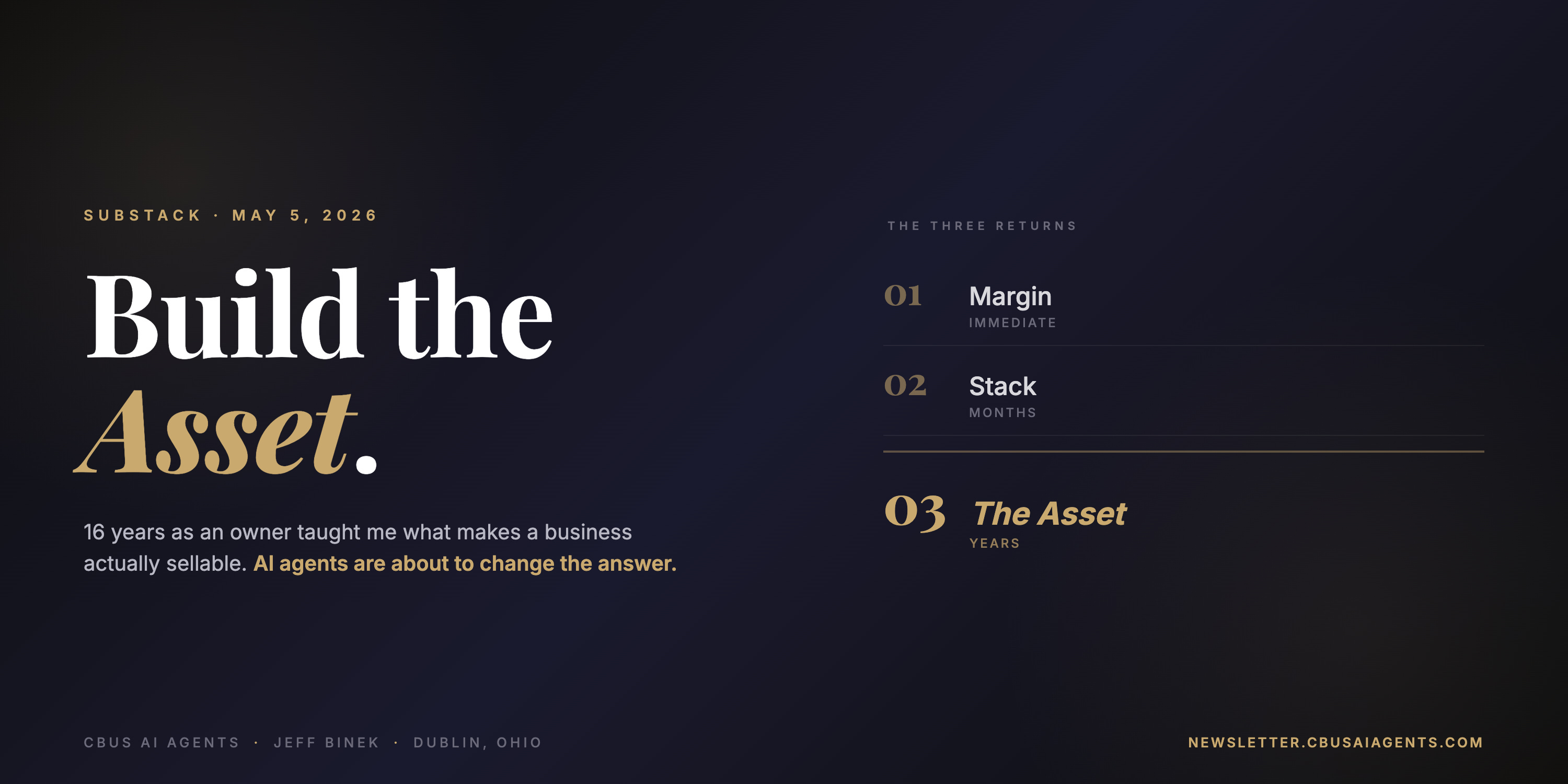
The three returns
Right now there are three different returns operating at three different timeframes, and they compound on each other.
The first return is immediate. The agent absorbs work you used to pay for: proposals, follow-ups, pipeline standups, post-close communications, content drafts, daily briefings. All of it inside your existing AI subscription. The hours you get back can be billed at your hourly rate, or spent on the parts of the business that actually grow it. For most owners I work with, the math closes inside the first 90 days.
The second return shows up in the stack. Most service businesses are running 10 to 15 subscriptions and one or two contractors to do work that an agent system handles natively. The marketing automation tool. The proposal software. The follow-up sequencer. The reporting tool. The intake form processor. None of those are wrong tools. They’re stacked because nothing else could do the job. When an agent can, the stack collapses on itself. Some owners see meaningful savings on the software bill within the first few months. That’s not the goal. The goal is the operating leverage. The savings fall out as a side effect.
The third return is the one nobody sees on the way in, and it’s by far the largest. It’s the asset on the way out. A service business with a documented, transferable, agent-run operating layer is a fundamentally different kind of sale than a service business that lives in the founder’s head. Bankers price it differently. Buyers see it differently. The pool of people who could plausibly run the company expands. None of this matters if you’re selling next quarter. All of it matters if you’re selling in five or 10 or 15 years.
Three returns. One investment. Different timeframes, all real.
Even if you never sell
The honest reason to do this work isn’t the sale. Most owners I talk to don’t have a sale in their five-year plan. They want to keep operating. That’s fine.
But the same structural choices that make a business sellable also make it livable. The owner who can step away for two weeks without the company faltering is the owner whose marriage doesn’t fray, whose kids see them at dinner, whose blood pressure goes down 20 points in the second year of the build. The structure isn’t an exit move. It’s a life move. The exit just becomes possible as a side effect of building the life.
You don’t have to be planning an exit to want that. You just have to be tired.
I was tired. For most of the 16 years I owned Friendship Fitness, I was tired in a way I’d convinced myself was the cost of the work. It wasn’t. It was the cost of building a business that couldn’t run without me.
If I were doing it today, I’d build something that could.
One small note before you close this
If you’ve read this far and you’re an owner thinking about how this maps to your business, I’m not going to run a full pitch. The Personal AI Agent Build and the Business AI Agent Build at CBus AI Agents are both designed around exactly this. We do a free 30-minute call before any paperwork. No pressure, no tricks. The link is on the site.
The point of this piece isn’t to sell. The point is to name something I think every service-business owner should be thinking about, regardless of whether they ever work with us.
Build the asset. Even if you never sell it.
— Jeff Binek
Sentinel #563, Dublin, Ohio